Why Losing Weight Is More Complicated Than “Eat Less, Move More”

If losing weight were simply a matter of knowing that we should eat less and move more, very few people would struggle with it.
Most of us already know the basics.
But knowing what to do and understanding everything that influences our ability to do it consistently are two very different things.
I know this personally. For years, I could lose weight—but maintaining it was another story. I tried different approaches, lost weight, regained it, and started over again.
What eventually changed wasn't finding the perfect diet.
It was learning how to eat and live in a way that supported my health and that I could actually continue.
And that's an important distinction, because successful weight management is about much more than getting the number on the scale to move.
“Eat Less, Move More” Doesn't Tell the Whole Story
At its most basic level, weight loss does require an energy deficit—over time, the body must use more energy than it receives from food.
So yes, calories matter.
But human beings aren't calorie calculators.
Our food intake is influenced by hunger, fullness, food availability, sleep, stress, emotions, habits, medications, social environments and countless other factors. Genetics can influence appetite, metabolism and body-fat distribution. And as we lose weight, the body itself can respond in ways that make continued weight loss and maintenance more difficult.
Energy expenditure may decrease. Hunger may increase. A smaller body requires less energy than a larger one.
In other words, the basic equation may be simple.
Living inside that equation is not.
That's one reason telling someone to “just eat less” isn't particularly helpful. A better question is: What makes it easier for this particular person to eat an appropriate amount of food, get the nutrients their body needs, feel satisfied and continue doing it over time?
That's where nutrition becomes much more interesting.
Calories Matter. But So Does Where They Come From.
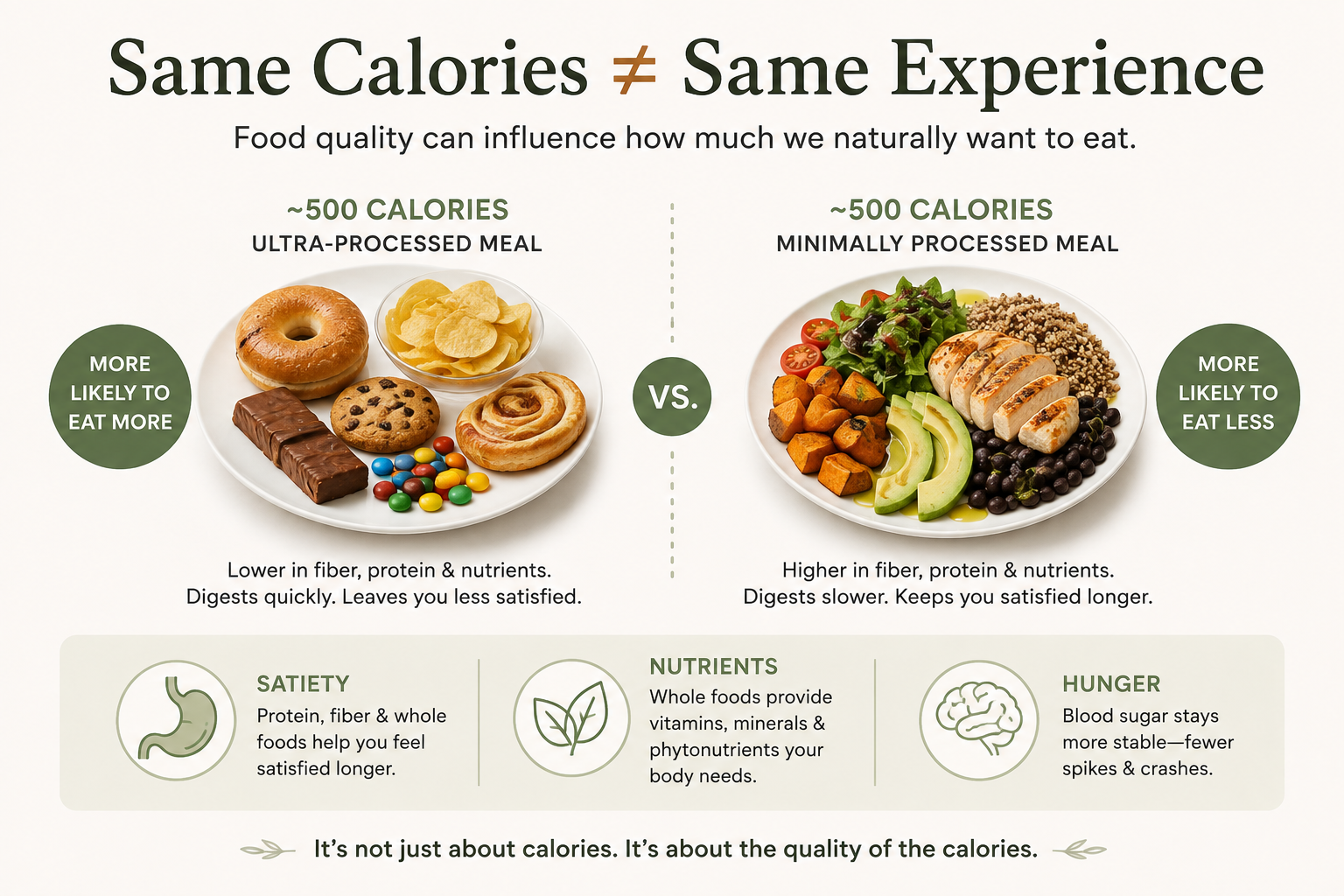
A calorie is a unit of energy. In that sense, 500 calories are still 500 calories regardless of where they come from.
But foods that contain the same number of calories don't necessarily affect our eating behavior in the same way.
Consider the difference between a meal built around protein, vegetables, beans or whole grains, and healthy fats versus 500 calories from highly processed snack foods.
Both provide energy.
But they can differ dramatically in protein, fiber, vitamins, minerals, water content, volume and how satisfying they are to eat.
This isn't just theoretical.
In a tightly controlled National Institutes of Health study, researchers gave adults either an ultra-processed or unprocessed diet for two weeks and then switched them to the other diet. The diets offered were designed to be similar in calories, macronutrients, sugar, sodium and fiber.
Participants were allowed to eat as much or as little as they wanted.
On the ultra-processed diet, they spontaneously ate about 500 more calories per day and gained weight. On the unprocessed diet, they ate less and lost weight.
That doesn't mean every processed food is “bad,” nor does healthy eating require eliminating everything that comes in a package.
It does tell us something important:
Food quality can influence how much food we naturally want to eat.
And that matters tremendously when we're trying to create eating habits that can last.
Build Meals That Work With Your Appetite
One of the biggest mistakes I see in weight-loss plans is focusing almost entirely on what needs to be removed.
Eat less.
Cut carbs.
Cut fat.
Skip breakfast.
Don't snack.
Stop eating after a certain time.
Sometimes reducing particular foods or portions is appropriate. But I would rather begin with another question:
What does your body need more of?
For many people, meals become much more satisfying when we intentionally include adequate protein, fiber-rich plants and healthy fats.
That might look like eggs with vegetables and avocado; Greek yogurt with berries, nuts and seeds; salmon with roasted vegetables and lentils; chicken with a large salad, beans and olive oil; or dozens of other combinations.
There isn't one magic meal.
The goal is to build meals that provide energy and nutrients while helping you remain comfortably satisfied.
When meals consistently leave you hungry an hour or two later, relying on willpower for the rest of the day isn't a particularly good long-term strategy.
There Is No Perfect Weight-Loss Diet
Low-carb. Low-fat. Mediterranean. Paleo. Keto. Plant-based. Intermittent fasting.
Nutrition can become confusing very quickly.
The good news is that research comparing popular dietary approaches has repeatedly shown that more than one approach can produce weight loss.
That means you don't have to discover the one perfect human diet before you can improve your health.
Different people have different medical histories, food preferences, cultures, schedules, budgets, cooking abilities, metabolic needs and relationships with food.
An eating pattern can look fantastic on paper and still be completely wrong for the person expected to follow it.
That's why one of my favorite principles remains very simple:
The best eating plan is one you can actually live with.
That doesn't mean nutritional quality doesn't matter. It does.
Ideally, the foundation includes plenty of vegetables and fruits, adequate protein, fiber-rich plant foods, nuts and seeds, minimally processed foods, and healthy sources of fat, while leaving room for flexibility and enjoyment.
But there are many ways to build that foundation.
Personalization matters.
What About GLP-1 Weight-Loss Medications?
The weight-loss landscape has changed dramatically in recent years with medications such as semaglutide (Wegovy) and tirzepatide (Zepbound).
These medications can produce substantial weight loss and meaningful improvements in metabolic health for appropriate patients. Tirzepatide acts on both GIP and GLP-1 receptors, while semaglutide acts on the GLP-1 receptor.
They affect appetite and satiety and can substantially reduce food intake.
For some people, these medications can be valuable tools.
But they don't make nutrition irrelevant.
I would argue that they make good nutrition even more important.
When appetite drops significantly, total food intake can drop significantly as well. That means there are fewer opportunities during the day to obtain adequate protein, vitamins, minerals, essential fats, fiber and other nutrients.
Loss of lean tissue is another consideration during substantial weight loss. Preserving muscle becomes increasingly important, particularly as we age. Adequate nutrition combined with resistance exercise can help support lean mass and overall function during weight loss.
And then there is the question of maintenance.
In an extension of the STEP 1 trial, participants who had lost substantial weight while taking semaglutide regained approximately two-thirds of their lost weight during the year after the medication was withdrawn.
A similar pattern has been seen with tirzepatide: participants who discontinued treatment experienced substantial weight regain, while those who continued treatment maintained or furthered their weight loss.
This doesn't mean these medications “don't work.”
Quite the opposite—they can work very well.
It means that obesity and weight regulation are complex, and for many people pharmacologic treatment may need to be long-term.
Whether someone plans to remain on medication or eventually discontinue it, nutrition, movement, muscle preservation and sustainable habits still matter.
Medication can be a tool. It shouldn't be the entire toolbox.
Don't Forget About Muscle

When people say they want to lose weight, what they usually mean is that they want to lose excess body fat.
Those aren't exactly the same goal.
Weight loss can include fat, water and lean tissue—including muscle.
And muscle is tissue we generally want to protect.
Muscle supports strength, mobility, glucose regulation, metabolic health and our ability to remain independent as we age. That's one reason I don't like weight-loss strategies that focus exclusively on making the scale drop as quickly as possible.
The quality of the weight being lost matters too.
Adequate protein and resistance exercise are especially important during weight loss because they provide the body with a reason—and the building blocks—to maintain muscle tissue.
Walking and other forms of cardiovascular activity are wonderful for health as well. Exercise improves far more than body weight, including cardiovascular fitness, insulin sensitivity, mood, brain health, physical function and overall quality of life.
Sometimes the scale gets far more attention than it deserves.
Why Maintaining Weight Loss Can Be Harder Than Losing It
This may be the most important part of the entire conversation.
Losing weight and maintaining weight loss are not the same challenge.
As body weight decreases, the body adapts.
A smaller body generally requires fewer calories. Energy expenditure can decrease beyond what would be expected simply from having a smaller body, and biological signals involved in appetite and weight regulation can favor regaining lost weight.
That's one reason weight loss often follows a familiar pattern:
The first several pounds come off relatively easily.
Then progress slows.
The scale stalls.
Hunger may increase.
The habits that felt manageable for three months begin to feel much harder at month nine.
This isn't evidence that someone's metabolism is “broken.”
It's evidence that the human body is very good at adapting.
And it helps explain why a temporary diet followed by a return to the same habits that existed before the diet rarely creates a permanent solution.
If the only way you can maintain your new weight is by continuing to “be on a diet,” something about the strategy probably needs to change.
The Goal Isn't Perfection
Weight loss is often presented as a short-term project:
Lose 20 pounds.
Reach a goal weight.
Finish the program.
But I think there is a better way to look at it.
Instead of asking:
“What do I need to do to lose this weight?”
try asking:
“What could I realistically continue doing after the weight is gone?”
Can you eat this way on vacation?
At a restaurant?
During a stressful week?
At Thanksgiving?
When you're busy and don't have time to cook?
Can you enjoy foods you love without feeling as though you've “failed”?
Can you miss a workout without abandoning exercise for the next three months?
That's where sustainable health is built.
You don't need a perfect diet. You don't need to exercise perfectly. And you certainly don't need to spend the rest of your life counting every calorie that enters your mouth.
You need habits that support your health often enough and consistently enough to make a difference.
For me, that was ultimately the difference between losing weight temporarily and changing my health for the long term.
Improving your health doesn't require perfection. It requires finding the right next steps—and building from there.
References
Hall KD, Ayuketah A, Brychta R, et al. Ultra-processed diets cause excess calorie intake and weight gain: An inpatient randomized controlled trial of ad libitum food intake. Cell Metabolism. 2019;30(1):67-77.e3. doi:10.1016/j.cmet.2019.05.008.
Ge L, Sadeghirad B, Ball GDC, et al. Comparison of dietary macronutrient patterns of 14 popular named dietary programmes for weight and cardiovascular risk factor reduction in adults: systematic review and network meta-analysis of randomised trials. BMJ. 2020;369:m696. doi:10.1136/bmj.m696.
Hall KD, Kahan S. Maintenance of lost weight and long-term management of obesity. Medical Clinics of North America. 2018;102(1):183-197. doi:10.1016/j.mcna.2017.08.012.
Wilding JPH, Batterham RL, Davies M, et al. Weight regain and cardiometabolic effects after withdrawal of semaglutide: The STEP 1 trial extension. Diabetes, Obesity and Metabolism. 2022;24(8):1553-1564. doi:10.1111/dom.14725.
Aronne LJ, Sattar N, Horn DB, et al. Continued treatment with tirzepatide for maintenance of weight reduction in adults with obesity: The SURMOUNT-4 randomized clinical trial. JAMA. 2024;331(1):38-48. doi:10.1001/jama.2023.24945.
Locatelli JC, Costa JG, Haynes A, et al. Incretin-based weight loss pharmacotherapy: Can resistance exercise optimize changes in body composition? Diabetes Care. 2024;47(10):1718-1730. doi:10.2337/dci23-0100.