What Is Functional Medicine—and What Does It Actually Look Like in Practice?

If you’ve heard the term functional medicine, you’ve probably also heard the phrase root cause. But functional medicine is a little more nuanced than simply searching for one hidden cause behind every health problem.
At its core, functional medicine is a personalized, systems-based approach to health. It looks at how different parts of the body interact and asks not only what is happening, but also why it may be happening and what may be contributing to it.
That distinction matters—especially with chronic health concerns, which rarely develop because of one isolated factor.
Functional Medicine Asks Different Questions
Conventional medicine is essential. It gives us diagnosis, medications, surgery, imaging, emergency care, and treatments that save lives every day.
Functional medicine isn't intended to replace that.
Instead, it can add another layer of investigation.
For example, rather than stopping with a diagnosis or an abnormal lab value, a functional approach may ask:
What factors contributed to this problem developing?
Are there nutritional deficiencies or insufficiencies involved?
What role might diet, sleep, stress, movement, or alcohol intake be playing?
Are digestion and absorption affecting nutrient status?
Are there early signs of metabolic dysfunction?
Could medications or supplements be influencing symptoms or lab values?
What does the person's health history tell us?
Are multiple body systems involved?
Often, there isn't one "root cause." There may be several contributing factors interacting with one another.
The goal is to identify the ones that are both important and changeable.
Your Body Doesn't Operate in Separate Compartments
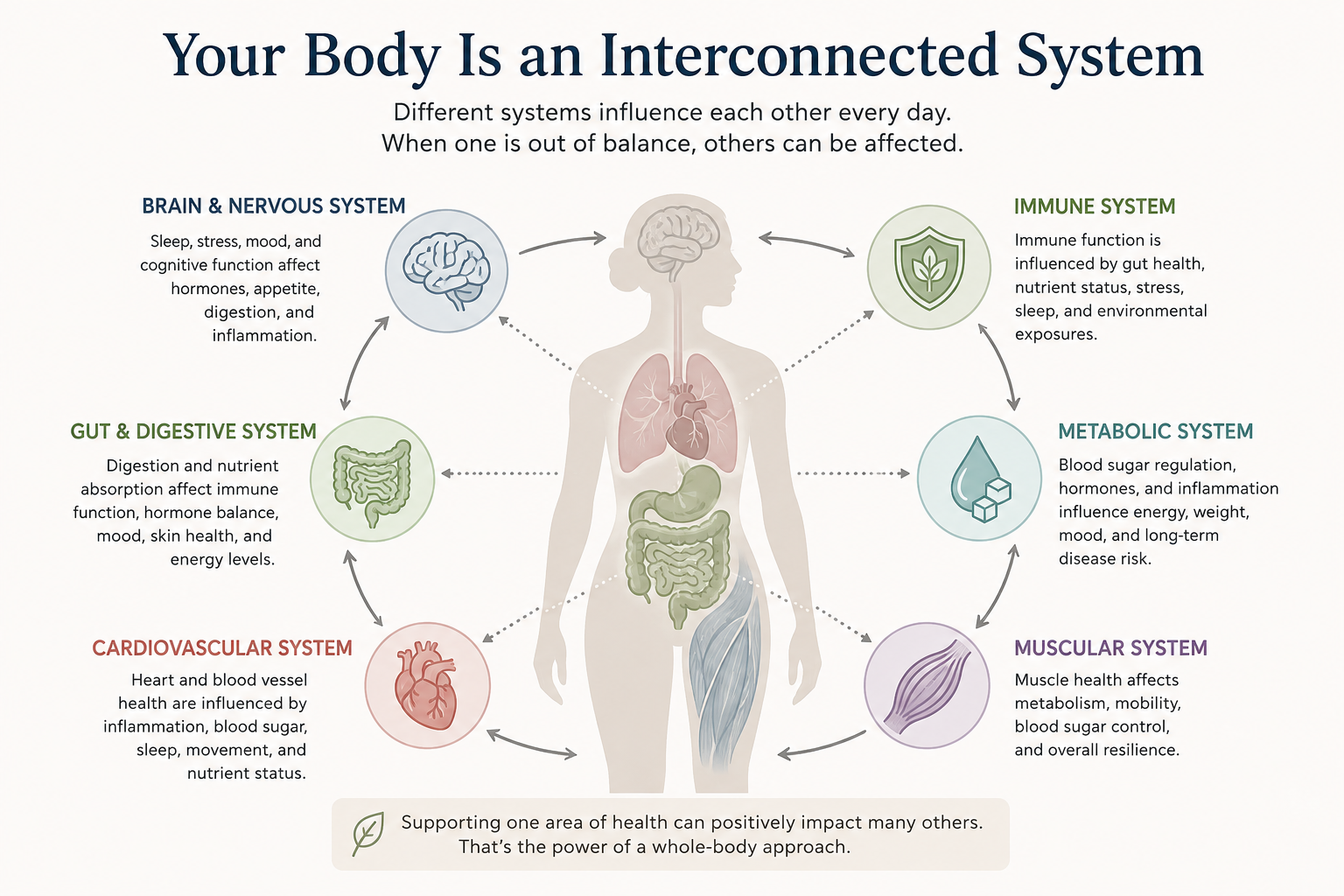
One of the concepts I appreciate most about functional medicine is its recognition that the body functions as an interconnected system.
Your gastrointestinal tract doesn't operate independently from your immune system. Your muscles aren't disconnected from your blood sugar regulation. Sleep influences hormones, appetite, glucose metabolism, inflammation, and cognition. Nutrient deficiencies can affect everything from energy production to red blood cell formation and neurological function.
Sometimes a symptom that appears to belong to one system has contributors somewhere else entirely.
This doesn't mean that everything causes everything. It means we need to consider the larger physiological picture instead of looking at each symptom or laboratory marker in isolation.
What Does a Functional Assessment Look Like?
A good functional assessment begins with something decidedly low-tech:
A really thorough history.
Before jumping to specialized testing or supplements, I want to understand the person sitting in front of me.
That may include:
Current symptoms and health concerns
Medical and family history
Medications and supplements
Eating patterns and nutrient intake
Digestive health
Sleep
Physical activity
Stress
Previous illnesses or significant health events
Weight and metabolic history
Existing laboratory results
Sometimes the timeline itself reveals important patterns.
And then, when appropriate, we can use laboratory testing to investigate further.
Laboratory Testing: More Isn't Always Better

Laboratory analysis can be an incredibly useful part of functional nutrition, but I don't believe that good functional care means ordering every specialty test available.
In fact, sometimes the most useful information is already sitting in someone's standard blood work.
A CBC, metabolic panel, lipid panel, glucose, hemoglobin A1c, thyroid markers, iron studies, or other common tests can reveal patterns that deserve a closer look—particularly when markers are interpreted together rather than individually.
In other situations, additional testing may be appropriate. Depending on the person and the clinical question, this could include more detailed assessment of nutrient status, glucose and insulin regulation, cardiovascular risk, gastrointestinal function, food allergies and sensitivities, hormones, inflammation, or other areas.
The question shouldn't be:
"What else can we test?"
It should be:
"What are we trying to understand, and will this test help us make a better decision?"
Testing should have a purpose.
Food Is More Than Calories

Nutrition is one of the most powerful tools we have for influencing health.
Food certainly provides energy, but it also provides amino acids, fatty acids, vitamins, minerals, fiber, and thousands of naturally occurring compounds that interact with human physiology.
In other words, food provides information.
The foods we eat influence blood glucose, insulin signaling, the gut microbiome, immune function, inflammation, vascular health, muscle protein synthesis, and countless other processes happening throughout the body.
This is why functional nutrition isn't simply about telling someone to "eat healthy."
The better question is:
What does this particular person's body need?
For one person, we may need to focus on improving protein intake. Someone else may need more fiber, iron, omega-3 fats, or overall calories. Another person may benefit most from reducing highly refined carbohydrates and improving blood sugar regulation.
Nutrition should be personalized—but it doesn't have to be complicated.
Lifestyle Is Part of Physiology
Food isn't the only signal your body receives.
Movement, sleep, stress, alcohol, smoking, social connection, and other aspects of daily life all influence human physiology.
Research increasingly supports lifestyle interventions as important components of the prevention and management of many chronic diseases.
That's why functional medicine and functional nutrition often spend more time exploring daily life than people expect.
How are you sleeping?
How much are you moving?
What is making healthy eating difficult?
Are you chronically stressed?
Can you realistically follow the plan you've been given?
That last question is especially important.
The most scientifically perfect plan in the world isn't very useful if someone can't actually live with it.
What About Supplements?
Supplements can absolutely have a place in a functional nutrition plan.
But supplements should supplement the plan—not become the plan.
When possible, I prefer to identify why something is being recommended.
Is there a documented deficiency? An inadequate dietary intake? A physiological reason for using it? Is there reasonable evidence supporting its use? Is the dose appropriate? Could it interact with medications or other supplements?
Taking a large collection of supplements simply because each one might do something beneficial isn't necessarily functional medicine.
Sometimes the best intervention is surprisingly simple.
Functional Medicine Doesn't Replace Conventional Medicine
This is an important distinction.
Functional medicine should not be positioned as an alternative to appropriate medical care.
There are times when medication is exactly what someone needs. There are times when surgery is necessary. Symptoms sometimes require diagnostic imaging, evaluation by a physician, or referral to a specialist.
Good care doesn't require choosing a "side."
Functional nutrition can work alongside conventional medical care by helping address nutrition, lifestyle, metabolic health, nutrient status, and other modifiable factors that influence health.
Collaboration between healthcare professionals is often in the patient's best interest.
Who Practices Functional Medicine?
The term functional medicine practitioner does not represent a single healthcare license.
Professionals from several healthcare disciplines may receive additional education in functional medicine, including physicians, nurse practitioners, chiropractors, dietitians, nutritionists, and other qualified healthcare professionals.
Their legal scope of practice, however, comes from their underlying professional credentials and the laws of the state in which they practice—not simply from calling themselves a functional medicine practitioner.
That's an important distinction when choosing someone to work with.
It's reasonable to ask about a practitioner's education, credentials, clinical training, scope of practice, and approach to evidence.
What Functional Medicine Looks Like at Nelms Nutrition
My approach to functional nutrition is investigative, but practical.
I want to understand what your body may be missing, what may be getting in the way, and what we can realistically do about it.
Sometimes that requires deeper laboratory investigation.
Sometimes the answer is sitting in labs that have already been run.
And sometimes we don't need another test at all.
We may need to improve protein or fiber intake, correct a nutrient deficiency, build muscle, support better blood sugar regulation, improve sleep, address digestive issues, or simply make eating well easier.
I believe in starting with the foundations and adding complexity only when complexity is useful.
Because improving your health doesn't require doing everything perfectly.
It requires figuring out which next steps matter most for you.
And that, to me, is what functional medicine should be about.
References & Further Reading
Agrawal, P., et al. (2024). Genetics, nutrition, and health: A new frontier in disease prevention. Journal of the American Nutrition Association, 43(4), 326–338. https://doi.org/10.1080/27697061.2023.2284997
D’Adamo, C. R., Kaplan, M. B., Campbell, P. S., et al. (2024). Functional medicine health coaching improved elimination diet compliance and patient-reported health outcomes: Results from a randomized controlled trial. Medicine, 103(8), e37148. https://doi.org/10.1097/MD.0000000000037148
Hyman, M., & Bradley, E. (2022). Food, medicine, and function: Food is medicine part 1. Physical Medicine and Rehabilitation Clinics of North America, 33(3), 553–570. https://doi.org/10.1016/j.pmr.2022.04.001
Keijer, J., et al. (2024). Omics biomarkers and an approach for their practical implementation to delineate health status for personalized nutrition strategies. Critical Reviews in Food Science and Nutrition.
Mitchelson, K. A. J., Ní Chathail, M. B., & Roche, H. M. (2023). Systems biology approaches to inform precision nutrition. Proceedings of the Nutrition Society, 82(2), 208–218. https://doi.org/10.1017/S0029665123002732
Integration of lifestyle medicine into primary care: A comprehensive review. (2026). Public Health Reports.https://doi.org/10.1177/00333549251403368