Do We Have Any Control Over Joint Pain?

Joint pain is incredibly common. Knees, hips, shoulders, hands, backs—at some point, most of us will probably experience it.
But when a joint hurts, it's easy to assume the problem is simply the joint itself.
Sometimes it is. An injury, structural change, repetitive movement or years of wear can certainly contribute to pain. But joints don't exist in isolation. They are living tissues affected by the immune system, metabolism, circulation, nutrition, movement, sleep, stress and the health of the body as a whole.
And inflammation is often somewhere in that picture.
That doesn't mean that every aching knee is caused by "inflammation," or that eliminating a few supposedly inflammatory foods will make joint pain disappear. Joint pain is much more complicated than that.
But it does mean we may have more influence over the environment surrounding our joints than we realize.
First, Inflammation Isn't Always the Enemy
We tend to talk about inflammation as though it's something we need to eliminate.
It isn't.
Inflammation is actually an essential part of the body's immune response. If you sprain your ankle, cut your finger or develop an infection, inflammatory signaling helps bring immune cells and other resources to the area so the body can protect and repair itself.
That short-term inflammatory response is normal—and necessary.
The problem is when inflammatory signaling becomes excessive, inappropriate or remains elevated longer than it should.
Chronic, low-grade inflammation can affect tissues throughout the body and is associated with many chronic diseases. It can also influence the environment inside and around our joints.
Even osteoarthritis, which was once viewed primarily as simple "wear and tear," is now understood to involve a much more complicated interaction between cartilage, bone, the joint lining, mechanical stress and inflammatory signaling.
So the goal isn't to eliminate inflammation.
The goal is healthy regulation of inflammation.
Why Do Joints Hurt?
There isn't one answer.
Joint pain can develop from injury, overuse, changes in cartilage or bone, altered movement patterns, autoimmune disease, gout, metabolic dysfunction and many other causes.
Conditions such as rheumatoid arthritis and ankylosing spondylitis involve significant immune-system activity. Gout involves the deposition of uric acid crystals within a joint. Osteoarthritis involves structural changes within the joint but also includes inflammatory and metabolic components.
And sometimes pain that feels as though it is coming from a joint is actually coming from surrounding tendons, ligaments, muscles or nerves.
This matters because the cause of the pain determines what needs to be addressed.
Nutrition can be an important piece of that puzzle, but it isn't the whole puzzle.
Your Immune System Is Constantly Communicating
One way the immune system communicates is through chemical messengers that can turn inflammatory activity up—or help bring it back down.
Cytokines, prostaglandins and leukotrienes are a few examples.
You don't need to remember their names.
What matters is that the environment around a joint is constantly receiving signals, and some of those signals can influence pain, swelling, tissue breakdown and repair.
Those signals don't come only from the joint itself.
They can also be influenced by what's happening throughout the rest of the body.
This is where nutrition, metabolic health, body composition, movement, sleep and stress become particularly interesting.
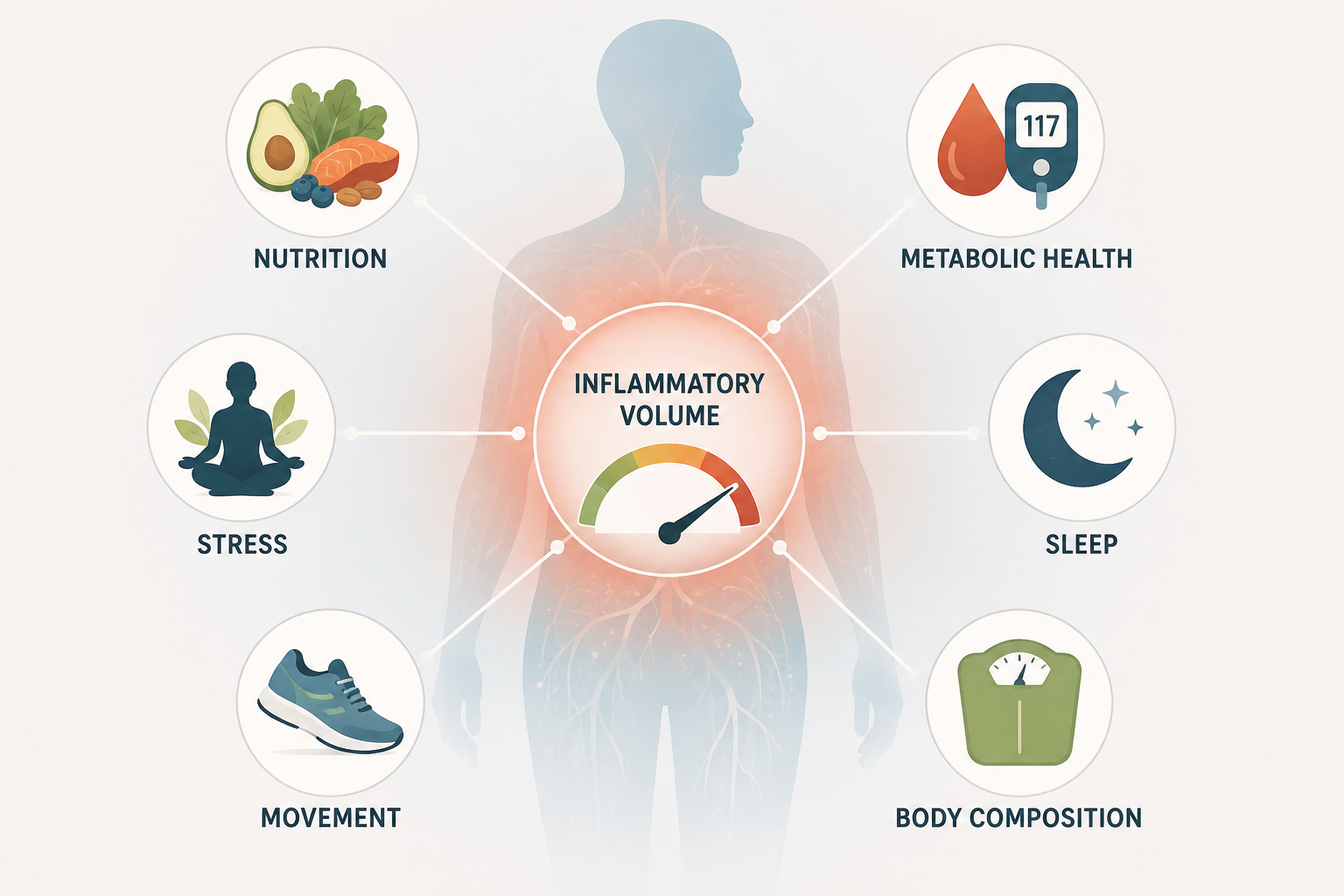
Inflammation isn’t influenced by just one thing—it reflects the combined signals coming from nutrition, metabolic health, movement, sleep, stress, and body composition.
What Can Turn Up the Inflammatory Volume?
There is rarely one single cause of chronic inflammation.
Instead, I like to think about the total environment we're creating for the body.
Several factors can influence inflammatory signaling, including:
smoking
poor sleep
chronic psychological stress
physical inactivity
excess visceral body fat
insulin resistance and poor glucose regulation
some chronic infections and health conditions
nutrient deficiencies
highly processed dietary patterns
excessive alcohol intake
None of these automatically means someone will develop joint pain. And changing one of them doesn't guarantee that pain will disappear.
But together, they help determine the physiological environment in which our joints—and every other tissue in the body—have to function.
Food Matters—But Probably Not in the Way Social Media Makes It Sound
I don't particularly like labeling individual foods as "inflammatory" or "anti-inflammatory."
Human biology is more complicated than that.
A single cookie doesn't suddenly inflame your joints, just as eating blueberries with breakfast doesn't instantly turn inflammation off.
What matters much more is the overall dietary pattern repeated over time.
A diet dominated by ultra-processed foods, refined carbohydrates, added sugars and excess calories creates a very different nutritional and metabolic environment than a diet built primarily around vegetables, fruits, beans, whole grains, nuts, seeds, fish, quality protein and minimally processed foods.
Research examining dietary patterns and osteoarthritis supports looking at the bigger picture. Healthier dietary patterns—including Mediterranean- and "prudent"-style patterns—have been associated with better osteoarthritis outcomes, while Western-style dietary patterns and diets with greater inflammatory potential have been associated with worse outcomes.
That doesn't mean there is one magical "anti-inflammatory diet."
There isn't.
It means the pattern matters.
Metabolic Health and Joint Pain
This is an area that deserves much more attention.
We often think about metabolic dysfunction—such as insulin resistance, elevated blood sugar and excess visceral fat—only in terms of diabetes or cardiovascular disease.
But metabolism affects much more than blood sugar.
Adipose tissue, particularly visceral fat stored around the abdominal organs, is biologically active tissue. It produces hormones and signaling molecules that can influence inflammation throughout the body.
Poor glucose regulation can also contribute to oxidative stress and the formation of advanced glycation end products, or AGEs, which can affect connective tissues and inflammatory pathways.
This helps explain why the relationship between body weight and joint health isn't purely mechanical.
Yes, carrying additional weight increases the physical load placed on weight-bearing joints such as the knees and hips.
But there is also a metabolic component.
That's an important distinction.
Fat tissue isn't simply stored energy. It communicates with the rest of the body.
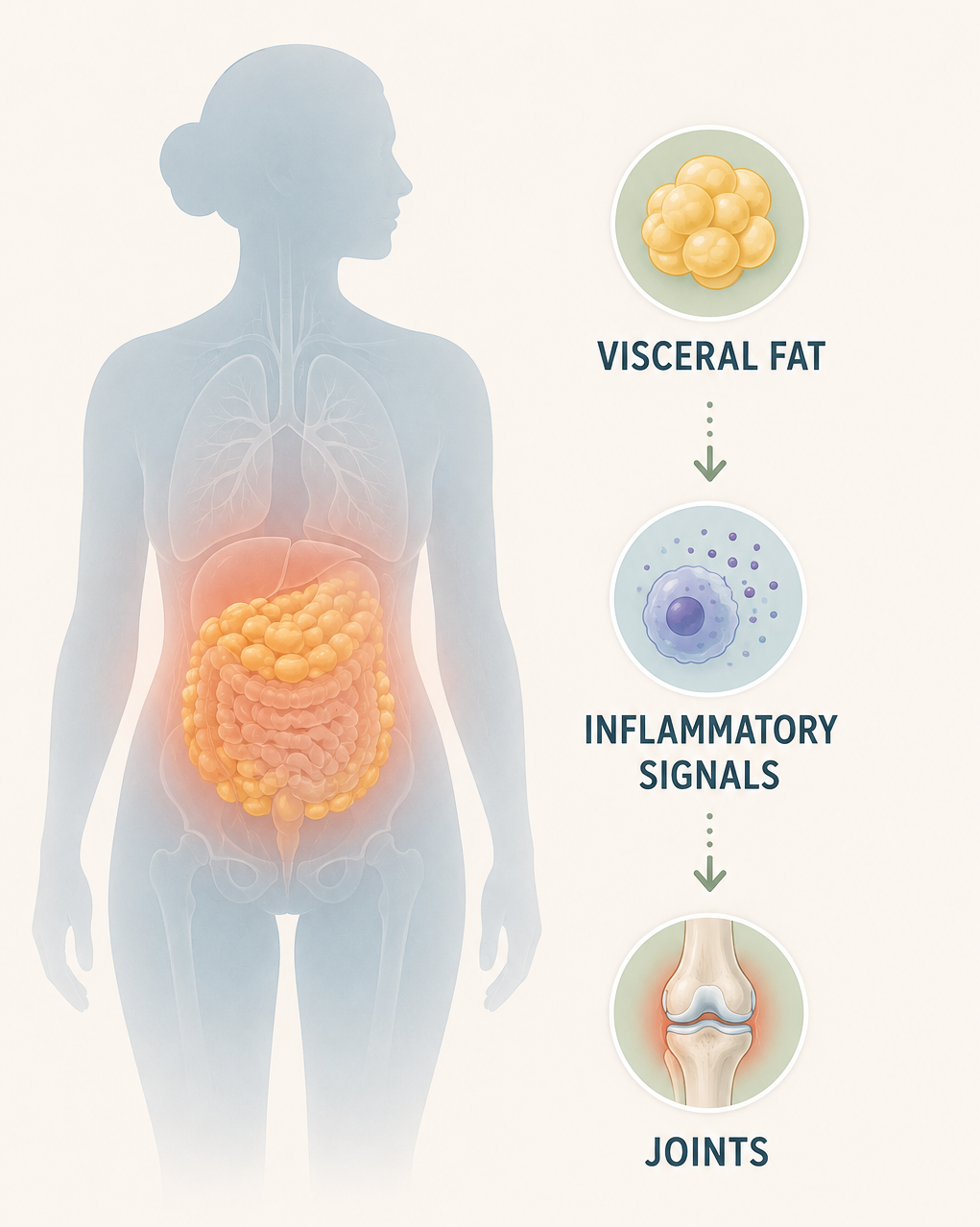
The relationship between body weight and joint health isn't only mechanical—fat tissue is biologically active and can influence inflammatory signaling throughout the body.
What Does an Anti-Inflammatory Eating Pattern Actually Look Like?
Despite all the attention given to "anti-inflammatory diets," there isn't one specific diet everyone needs to follow.
The basic principles are surprisingly simple.
Build most meals around minimally processed foods and include plenty of:
Colorful plants. Vegetables, fruits, herbs and spices provide vitamins, minerals, fiber and thousands of naturally occurring plant compounds that interact with human biology.
Fiber-rich foods. Beans, lentils, vegetables, fruits, nuts, seeds and intact whole grains help support the gut microbiome, glucose regulation and metabolic health.
Adequate protein. Protein provides the amino acids needed to maintain and repair muscle and connective tissues. Maintaining muscle becomes increasingly important as we age.
Healthy fats. Foods such as extra-virgin olive oil, nuts, seeds, avocado and fatty fish provide fats that can support cardiovascular and metabolic health.
Omega-3-rich seafood. Salmon, sardines, trout and other fatty fish provide EPA and DHA, omega-3 fatty acids involved in inflammatory regulation.
And then leave room for being human.
An anti-inflammatory eating pattern does not require dietary perfection.
What you do consistently matters much more than what you do occasionally.

An anti-inflammatory eating pattern isn't about a few “superfoods”—it's the overall pattern of foods you eat consistently that matters most.
Weight Loss Can Help—But It Isn't the Only Reason Nutrition Matters
For someone with overweight or obesity and knee or hip osteoarthritis, even modest weight loss can improve symptoms and function.
Part of the benefit is mechanical: less body weight means less force traveling through weight-bearing joints.
But again, that's not the entire story.
Improvements in insulin sensitivity, inflammatory signaling, physical function and body composition may contribute as well.
This is why I prefer focusing on improving metabolic health and body composition, rather than simply chasing a number on the scale.
Someone can improve their physiology before reaching whatever they consider their "goal weight."
Don't Forget Stress and Sleep
These are easy to overlook.
Chronic stress affects the nervous, endocrine and immune systems. Poor sleep can also alter pain perception and inflammatory regulation.
And pain itself makes both problems worse.
Pain disrupts sleep. Poor sleep increases pain sensitivity. Increased pain creates stress. Stress can make sleep more difficult.
It can become a cycle.
This doesn't mean joint pain is "in your head."
It means pain is produced by a nervous system that is constantly integrating information from the body and the environment.
Supporting sleep and stress regulation can therefore be an important part of managing chronic pain—even when there is a very real physical problem within the joint.

Movement Is Part of the Treatment
When something hurts, our natural instinct is often to stop moving it.
Sometimes temporary rest is exactly what's needed, particularly after an acute injury.
But for many chronic joint conditions, long-term inactivity can make things worse.
Muscles help support and stabilize joints. Movement helps maintain mobility and function. Resistance training helps preserve muscle and bone. Appropriate physical activity also improves insulin sensitivity, circulation and metabolic health.
Exercise is considered a core treatment for osteoarthritis because it can improve both pain and physical function.
The key word is appropriate.
The right type and amount of movement depends on the person, the joint involved and the underlying cause of the pain.
For one person that might mean walking and strength training.
For another it might begin with physical therapy, aquatic exercise, cycling or gentle mobility work.
The answer isn't necessarily "exercise harder."
It's finding movement your body can tolerate, recover from and gradually adapt to.
Can Supplements Help?
Possibly—but this is another area where marketing tends to move faster than the science.
Some supplements have evidence suggesting potential benefits for certain types of joint pain. Curcumin, the best-known active component of turmeric, and extracts of Boswellia serrata are two examples that have been studied in osteoarthritis.
Research has found improvements in pain and physical function in some trials, but studies vary considerably in their size, quality, dosage and formulations.
And that last part is important.
Seeing "turmeric" on the front of a bottle doesn't mean the product contains the same curcuminoid concentration, formulation or dose used in a clinical trial.
The same applies to many supplements.
Natural doesn't automatically mean effective—and the name of an ingredient doesn't tell us whether the dose, extract or formulation matches what was actually studied.
Other nutrients may be important when someone is deficient or has an increased need, including vitamin D, magnesium, omega-3 fatty acids and others. But supplements are best selected based on the individual rather than from a generic "joint health" list.
More isn't necessarily better.
Don't Forget the Mechanical Side of Joint Pain
Nutrition can't correct every cause of joint pain.
Sometimes the problem requires attention to strength, mobility, biomechanics, previous injury or the way forces are being distributed through a joint.
Physical therapy, appropriately programmed exercise and, in some cases, manual therapies can be useful parts of a comprehensive plan.
Persistent or unexplained joint pain also deserves appropriate medical evaluation.
Particularly important reasons to seek evaluation include sudden severe joint pain, significant swelling, redness or warmth, fever, an inability to bear weight, pain following an injury, prolonged morning stiffness, or persistent symptoms involving multiple joints.
Nutrition should complement appropriate medical care—not replace it.

So, Do We Have Any Control Over Joint Pain?
Sometimes, quite a bit.
Other times, less than we'd like.
Joint pain isn't one thing. Inflammation isn't one thing. And there isn't one food, supplement or lifestyle change that fixes it.
But the environment surrounding our joints is influenced by metabolism, immune signaling, body composition, nutrition, movement, stress, sleep and recovery.
Many of those factors are modifiable.
And that's the part I find encouraging.
You don't have to eat perfectly.
You don't have to eliminate every food you've ever heard described as "inflammatory."
And you don't need a cabinet full of supplements.
Start by creating a healthier environment for your body: nourish it well, move it regularly, build and maintain muscle, support metabolic health, prioritize sleep, manage stress where you can, and investigate persistent symptoms rather than simply learning to live with them.
Sometimes improving health isn't about finding one dramatic solution.
It's about identifying what your body needs—and taking the right next steps.