Methylation Is More Than MTHFR: What Your Genes Can - and Can't - Tell You

MTHFR is just one piece of a much larger and interconnected methylation puzzle.
If you've spent much time reading about nutrition, genetics or functional medicine, you've probably heard of MTHFR.
You may have even been told that you have an MTHFR variant and therefore have a "methylation problem."
But there's an important distinction:
Testing MTHFR is not the same thing as testing methylation.
MTHFR is one gene involved in a much larger network of reactions. Knowing which version of that gene you inherited can provide useful information about your genetic predisposition—but it doesn't necessarily tell us how that system is functioning in your body today.
And that's where things get much more interesting.
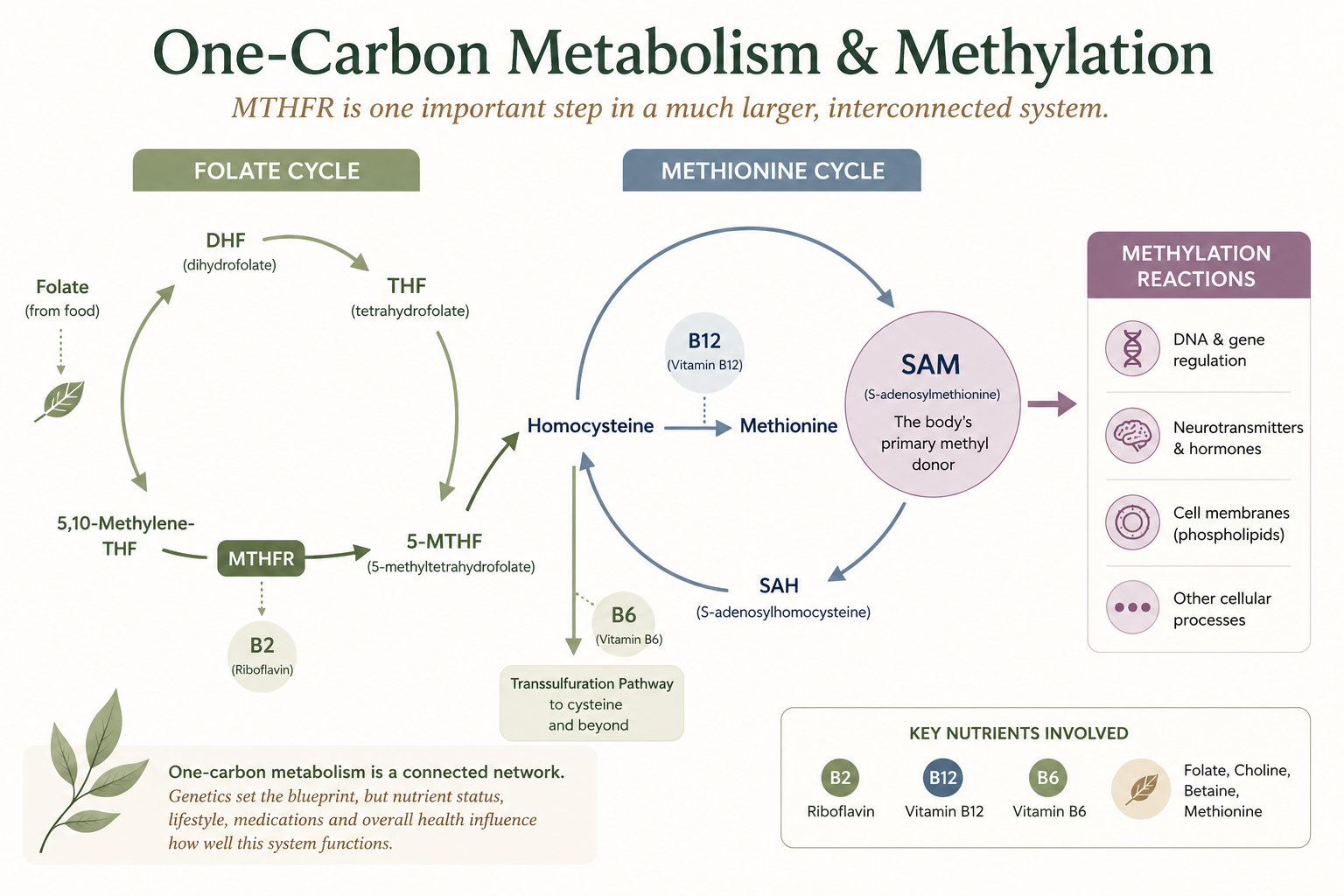
First, What Is Methylation?
The word methylation sounds complicated, but the basic concept isn't.
A methyl group is a tiny chemical structure made of one carbon atom and three hydrogen atoms.
Your body constantly moves these small carbon-containing groups from one molecule to another. Adding a methyl group can change what a molecule does, how it behaves or how it is processed.
Think of it almost like placing a tiny chemical "tag" onto something.
These methylation reactions happen throughout the body and are involved in processes such as:
regulating gene activity
making and metabolizing certain neurotransmitters and hormones
processing homocysteine and methionine
building and maintaining cell membranes
supporting normal DNA and cellular function
helping regulate many other metabolic reactions
In other words, methylation isn't a single reaction occurring in one part of the body.
It's chemistry your cells use every day.
So What Is One-Carbon Metabolism?
This is where methylation connects to an even bigger system called one-carbon metabolism.
Despite the intimidating name, "one-carbon" is quite literal.
Your body has an elaborate network designed to collect, carry and transfer small chemical units containing a single carbon atom.
You can think of it as a cellular delivery system.
Nutrients from food enter this system, are transformed through a series of enzyme-controlled reactions, and ultimately help provide the one-carbon units needed for important cellular jobs.
One-carbon metabolism includes two closely connected pathways:
The folate cycle
and
The methionine cycle
These pathways help your body produce nucleotides needed to make DNA and RNA, maintain amino-acid balance, regulate methylation reactions and support antioxidant/redox systems.
Several nutrients participate in this network.
Folate, vitamin B12 and vitamin B6 serve as important cofactors, while nutrients and amino acids including methionine, choline, betaine and serine can contribute carbon units or methyl groups to the system.
That is an important piece of the methylation conversation:
Your genes matter. But so does the nutritional and metabolic environment in which those genes are operating.
Meet SAM: The Body's Major Methyl Donor
Eventually, the methionine cycle produces a molecule called S-adenosylmethionine, or SAM.
SAM is particularly important because it is one of the body's major methyl donors.
You can think of SAM as a loaded delivery truck carrying a methyl group.
When an enzyme needs to methylate another molecule, SAM can donate that methyl group. After donating it, SAM becomes S-adenosylhomocysteine (SAH), which is subsequently processed through the pathway.
SAM and SAH therefore connect nutrient metabolism with methylation reactions occurring throughout the cell. Research has demonstrated that changes in methionine metabolism and SAM/SAH availability can influence cellular methylation processes.
And this is one reason methylation cannot realistically be reduced to a single gene.
There is an entire metabolic system involved.
Where Does MTHFR Fit Into All of This?
MTHFR stands for methylenetetrahydrofolate reductase.
Thankfully, you don't need to remember that or pronounce it.
What matters is that the MTHFR enzyme performs an important step within the folate cycle. It helps produce 5-methyltetrahydrofolate (5-MTHF), a form of folate used in the pathway that converts homocysteine back into methionine.
Methionine can then be used to produce SAM.
So yes—MTHFR absolutely matters to one-carbon metabolism.
But it is one enzyme within a much larger system.

What Does an MTHFR Genetic Test Actually Tell You?
The two commonly discussed MTHFR variants are:
C677T
and
A1298C
These genetic variants can alter MTHFR enzyme activity. Research has demonstrated reduced enzyme activity with these common polymorphisms, although the magnitude and clinical significance vary depending on the variant, whether someone carries one or two copies, folate status and other factors.
But here's the distinction I think is often missed:
Your DNA tells us what you inherited.
Your biochemistry tells us what is happening now.
An MTHFR test can identify a genetic variant that may influence how efficiently one step in this pathway operates.
It cannot, by itself, tell us whether the entire methylation system is currently functioning poorly.
That's a little like finding out that one model of engine has a component that operates somewhat differently and assuming you now know exactly how the entire car is running.
You don't.
You know something useful about its design.
To understand how the car is actually running, you need more information.
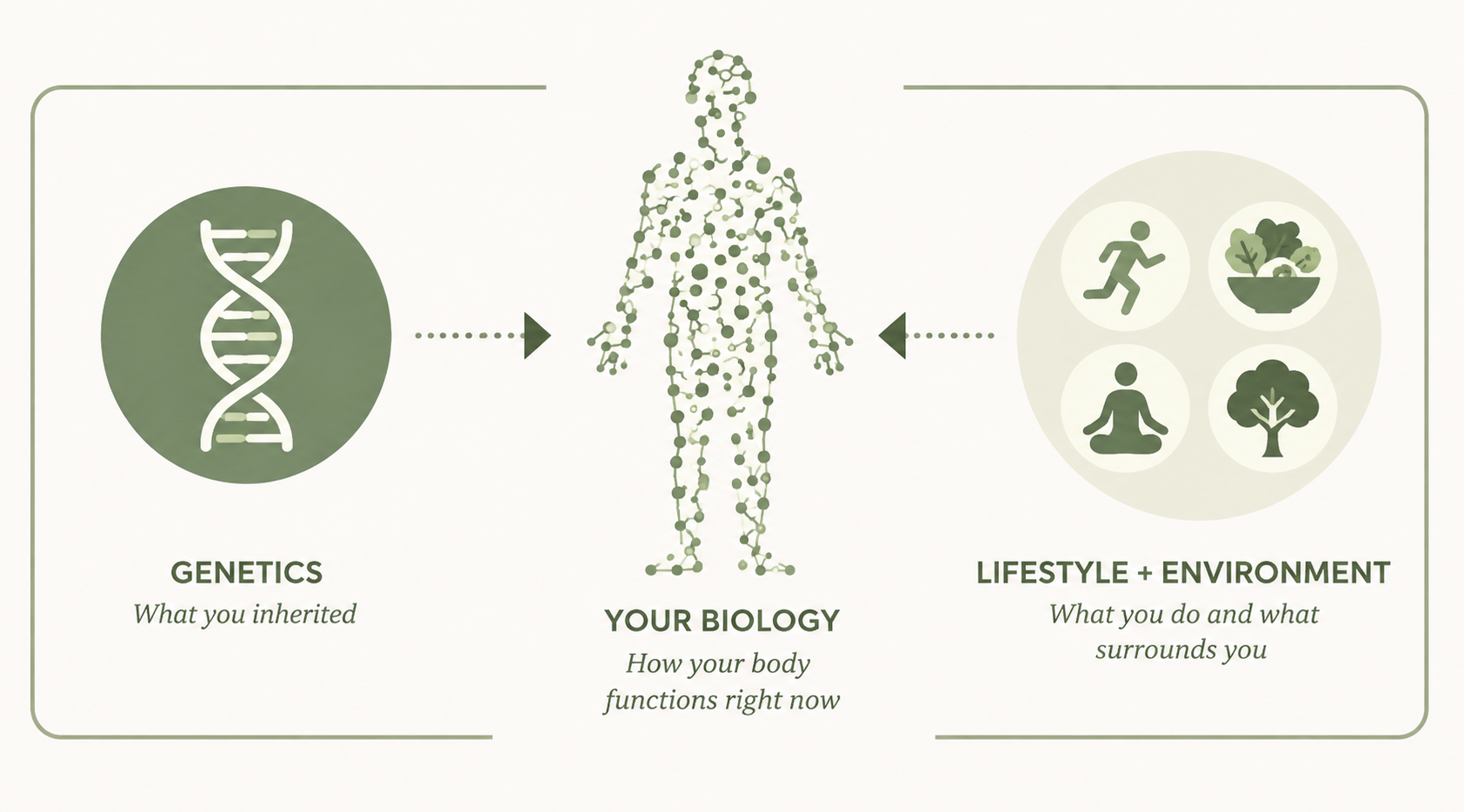
Your genes provide the blueprint, but your lifestyle, environment, and current physiology help determine how that blueprint is expressed.
Predisposition Is Not the Same as Dysfunction
This distinction applies to genetic testing in general.
Our genes can influence our biology, but they don't operate in isolation. They interact with the environment around them—including nutrition, lifestyle, exposures and other physiological factors. This relationship is closely tied to epigenetics: mechanisms that help regulate which genes are turned up, turned down or silenced without changing the underlying DNA sequence. DNA methylation is one of the best-studied ways this epigenetic regulation occurs.
This same gene-environment interaction matters when we look at one-carbon metabolism. Nutritional status, medications, health conditions and other metabolic factors can influence how these pathways function. The availability of folate, B12, B6, methionine, choline, betaine and other compounds can affect different portions of these interconnected pathways.
That means two people carrying the same MTHFR variant do not necessarily have identical biochemistry.
One may have perfectly unremarkable functional markers.
The other may show evidence that portions of one-carbon metabolism deserve further attention.
The gene hasn't changed. The metabolic environment has.
This Is Why I Don't Look at MTHFR in Isolation
When someone wants to understand their "methylation," I am interested in more than whether a particular MTHFR variant is present.
I want to understand the pathway around it.
That means considering genetic information alongside appropriate functional markers, nutrient status and relevant metabolic intermediates.
For example, homocysteine can provide information about what is occurring at an important intersection between the methionine cycle, remethylation and transsulfuration pathways.
Functional nutrient markers can provide additional information as well. For example, methylmalonic acid can help assess functional vitamin B12 status, while homocysteine may respond to changes in folate and B12 status.
That doesn't mean one abnormal marker diagnoses a "methylation disorder."
It means we're moving beyond asking:
"Which gene variant do you have?"
and beginning to ask:
"What does your current biochemistry tell us about how this system is functioning?"
That's a much more useful question.
And MTHFR Isn't the Only Gene Involved
Another reason the topic becomes confusing is that MTHFR is often discussed as though it is the methylation pathway.
It isn't.
Many enzymes and genes participate in folate metabolism, the methionine cycle, transsulfuration and methylation reactions throughout the body.
You may have heard of genes such as COMT, for example.
COMT—catechol-O-methyltransferase—is involved in methylating catechol compounds and uses SAM as a methyl donor. But adding COMT testing to MTHFR still doesn't create a comprehensive "methylation test."
It simply provides genetic information about another part of a very large biochemical system.
That's why increasingly large genetic panels don't necessarily provide increasingly useful answers.
More genetic data isn't always the same thing as more clinically meaningful information.
Can MTHFR Predict Disease?
This is another area where caution is warranted.
MTHFR variants have been studied in relation to many different diseases, but associations between common MTHFR polymorphisms and disease risk have frequently been inconsistent.
A 2024 peer-reviewed review concluded that common MTHFR testing has limited utility for estimating disease risk and emphasized that measuring relevant biochemical markers, such as homocysteine when appropriate, may provide more clinically useful information than relying on MTHFR genotype alone.
This is important because having an MTHFR variant does not automatically mean something is wrong with you.
Common genetic variants are just that—common.
And genetic information should be interpreted in context rather than treated as a diagnosis.

Is There One Test That Measures "Methylation"?
Not really.
This may be the most important takeaway.
Methylation occurs in an enormous number of reactions throughout the body. There isn't one routine blood test that gives you a simple score saying:
"Your methylation is 82%."
Different tests answer different questions.
Genetic testing can tell us about inherited variants.
Nutrient testing can tell us whether important cofactors are available.
Metabolic markers can give us clues about pathway activity.
Other specialized measurements can evaluate compounds involved more directly in methyl-group metabolism.
Each is a piece of information.
The skill is in understanding which pieces matter for the person sitting in front of you—and how they fit together.

The Bigger Picture
I think methylation has become unnecessarily confusing.
At one extreme, MTHFR is sometimes blamed for an enormous range of symptoms and health conditions.
At the other, the entire subject can be dismissed because MTHFR testing itself is frequently overused.
Neither approach captures the biology particularly well.
Methylation is real, essential cellular chemistry.
MTHFR is part of it.
But MTHFR is not methylation.
If we want to understand what is happening in someone's body, genetic predisposition can be one piece of the puzzle—but it shouldn't automatically be mistaken for current physiology.
Your genes can tell us what could happen.
Your biochemistry helps us understand what is happening.
And when it comes to personalized nutrition, that's the distinction that matters.