Hormesis: Why a Little Stress Can Make Your Cells Stronger

We usually think of stress as something to avoid.
Too much stress can certainly be harmful. But biologically, the complete absence of stress isn't necessarily ideal either.
Our bodies are designed to respond to challenges.
Exercise challenges our muscles. Heat challenges our ability to regulate temperature. Periods without food temporarily change our energy supply. Even certain compounds naturally produced by plants can create small challenges inside our cells.
When the challenge is manageable, something interesting can happen:
The body adapts.
This phenomenon is known as hormesis—the idea that a relatively small stress can activate protective responses that ultimately make cells and tissues better prepared to handle future challenges.
It's one of my favorite concepts in human physiology because it changes the way we think about stress.
Sometimes the goal isn't to eliminate the stressor.
Sometimes the response to the stressor is where the benefit occurs.
Hormesis: It's All About the Dose
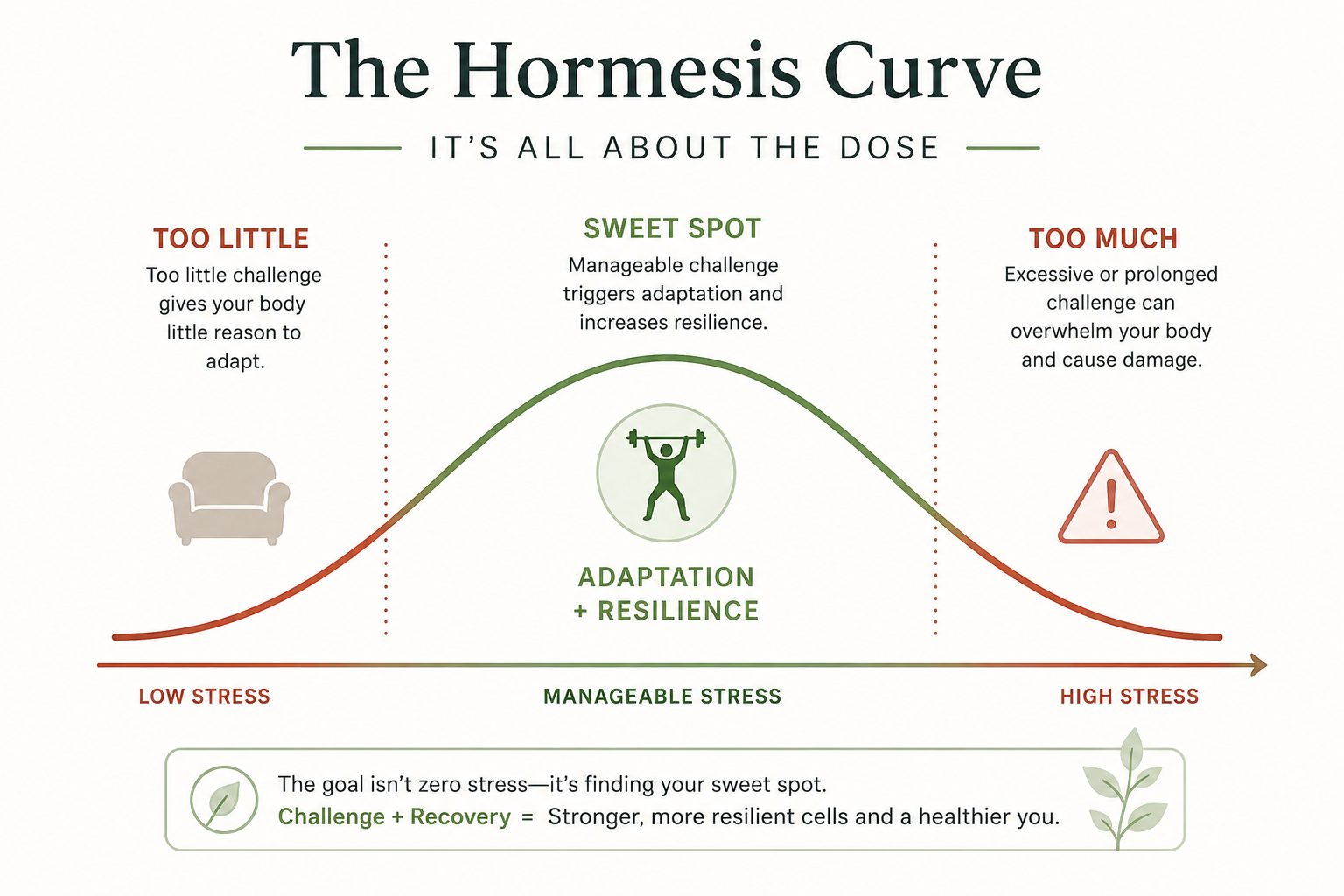
One of the easiest ways to understand hormesis is through exercise.
When you lift weights, you're deliberately placing stress on your muscles.
That stress isn't inherently beneficial. If the load is excessive, it can cause injury.
But when the challenge is appropriate—and followed by adequate nutrition and recovery—the body responds by repairing and adapting.
Over time, you become stronger.
This basic principle occurs throughout biology.
Too little challenge → little reason to adapt
Manageable challenge → adaptation and increased resilience
Excessive or prolonged challenge → potential damage
This is known as a hormetic dose-response.
And it helps explain why saying something is simply "good" or "bad" for us often misses an important part of the biology.
Dose matters. Duration matters. Context matters. And the body's ability to recover matters.
Your Mitochondria Need a Challenge Too
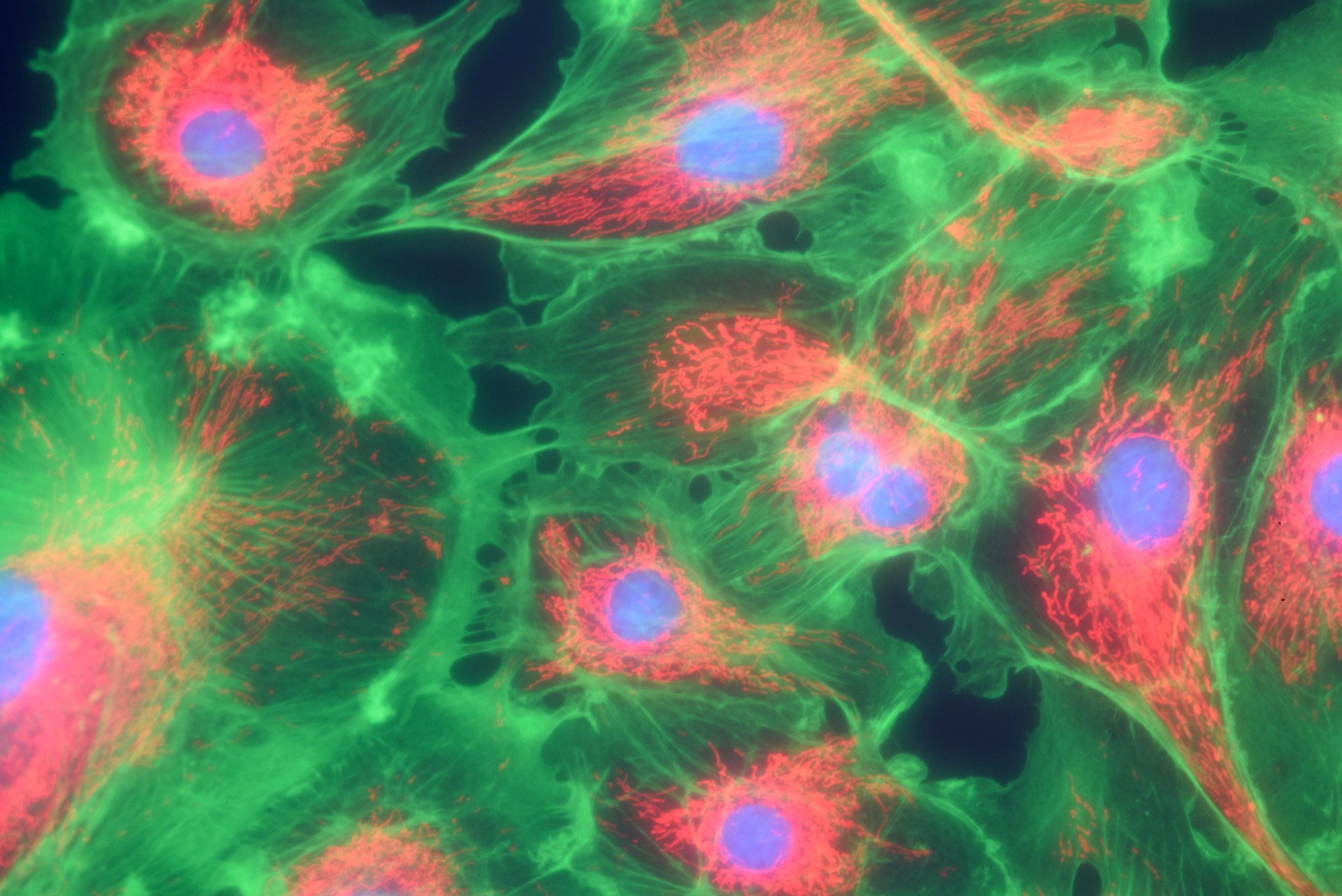
Hormesis doesn't just happen at the level of muscles and tissues.
It happens inside our cells.
This brings us to mitohormesis.
Most people learned that mitochondria are the "powerhouses of the cell." That's true—but incomplete.
Mitochondria help convert energy from food into ATP, the form of energy our cells can actually use. But mitochondria are also highly responsive structures involved in sensing changes in energy availability, nutrients, oxidative conditions and other forms of cellular stress.
When cells experience a manageable challenge, mitochondria participate in signaling that helps the cell determine:
Something has changed. How should we respond?
And one of the most interesting messengers involved in this process is something we've spent decades trying to eliminate:
reactive oxygen species.
Not All Free Radicals Are Bad
Reactive oxygen species, or ROS, are often referred to broadly as "free radicals."
They have a terrible reputation.
And there's a reason for that.
When reactive oxygen species become excessive or poorly controlled, they can damage cellular membranes, proteins, DNA and other structures. Chronically elevated oxidative stress is associated with numerous disease processes.
But that's only half the story.
At lower, temporary levels, reactive oxygen species also function as important signaling molecules.
Hydrogen peroxide, for example, isn't simply toxic cellular waste. At appropriate concentrations, cells use it as part of a sophisticated communication system.
This distinction is important:
Oxidative signaling is not the same thing as oxidative damage.
A temporary increase in reactive oxygen species can essentially tell the cell:
"We're being challenged. Prepare accordingly."
The cell can then activate protective pathways that help it become better equipped to handle future challenges.
That's mitohormesis.
The Cell Has Its Own Antioxidant Defense System
This is also where our traditional understanding of antioxidants becomes much more interesting.
We often talk about antioxidants as compounds we obtain from food or supplements that travel around the body neutralizing free radicals.
But our cells manufacture an extensive antioxidant defense system of their own.
That system includes:
Glutathione, one of the body's most important intracellular antioxidant and redox systems
Superoxide dismutase (SOD), which converts superoxide into hydrogen peroxide
Catalase, which helps break hydrogen peroxide down into water and oxygen
Glutathione peroxidase (GPx), which uses glutathione to help reduce hydrogen peroxide and lipid peroxides
Numerous additional enzymes involved in redox balance, detoxification, repair and cellular protection
And here's the fascinating part:
A mild cellular challenge can stimulate the systems responsible for protecting the cell from future challenges.
Instead of simply supplying the cell with something that neutralizes an oxidant, hormesis can encourage the cell to strengthen its own defenses.
Meet NRF2: One of the Cell's Major Defense Coordinators
One of the important pathways involved in this response is controlled by a protein called NRF2.
Under normal conditions, NRF2 is kept relatively quiet by another protein called KEAP1.
When cells encounter certain types of oxidative or chemical stress, that relationship changes.
NRF2 can then accumulate and move into the nucleus—the part of the cell containing our DNA—where it helps activate genes involved in cellular defense.
These genes influence systems involved in:
glutathione production and recycling
antioxidant enzyme activity
detoxification
protection from oxidative damage
cellular repair and maintenance
You can think of NRF2 somewhat like a cellular defense coordinator.
A challenge occurs.
NRF2 helps receive the message.
The cell responds by increasing its protective capacity.
And this is where the story takes an unexpected turn.
Plants Fight Back, Too

Plants encounter stress just like we do.
They face insects, fungi, bacteria, drought, temperature changes and ultraviolet radiation.
But plants have one obvious disadvantage:
They can't leave.
A broccoli plant can't run away from an insect.
A blueberry bush can't move into the shade.
So plants developed sophisticated chemical defense systems.
They produce thousands of compounds that help protect them from predators and environmental challenges.
And when we eat plants, we consume some of those compounds.
For years, we've largely described many of these substances as antioxidants.
"Blueberries are good for you because they're high in antioxidants."
"Broccoli contains antioxidants."
"Green tea contains antioxidants."
There's truth in those statements.
But they're incomplete.
Some plant compounds may benefit us not simply because they directly neutralize oxidants, but because they create a small biological challenge that activates our own cellular defense systems.
In other words:
The plant compound doesn't necessarily do all the protecting itself.
It may signal our cells to become better at protecting themselves.
Broccoli Provides a Great Example
One of the best-studied examples is sulforaphane.
Sulforaphane is produced from glucoraphanin, a glucosinolate found in cruciferous vegetables such as:
broccoli
broccoli sprouts
Brussels sprouts
cabbage
kale
cauliflower
Sulforaphane interacts with the KEAP1-NRF2 system and can activate genes involved in cellular protection and antioxidant defenses.
That's very different from imagining sulforaphane traveling around the body with a tiny broom sweeping up free radicals.
Instead, it's more like ringing a cellular alarm:
"Something is happening. Increase defenses."
And the cell responds.
This helps explain why the relationship between plant foods and human health is far more complex than simply counting how many "antioxidants" a food contains.
So...Are "Antinutrients" Actually Good for Us?
This is where we need some nuance.
The term antinutrient gets thrown around frequently in nutrition conversations.
Phytates, lectins, tannins, oxalates and glucosinolates may all end up under this umbrella.
They're called antinutrients because certain compounds can interfere with nutrient absorption, digestive enzymes or other physiological processes under particular circumstances.
But lumping all of these compounds together as simply "bad" isn't scientifically useful.
Neither is swinging to the opposite extreme and claiming that all antinutrients are beneficial because they're hormetic.
They're chemically different compounds with different biological effects.
Some plant phytochemicals—including certain polyphenols and isothiocyanates such as sulforaphane—have substantial evidence showing that they interact with cellular stress-response pathways.
For others, evidence of beneficial mitohormesis is much less established.
And individual circumstances matter.
Oxalates, for example, may be particularly relevant for certain people prone to calcium oxalate kidney stones. Phytates can bind minerals, although their effects depend heavily on the overall diet and nutritional status. Improperly prepared legumes containing high concentrations of active lectins can cause significant gastrointestinal illness.
So the lesson isn't:
"Antinutrients are good."
And it isn't:
"Antinutrients are bad."
The better lesson is:
The compound matters.
The dose matters.
The food matters.
The person matters.
Biology rarely operates in absolutes.
Exercise May Be the Easiest Way to See Hormesis in Action
Now let's return to something familiar.
Exercise temporarily increases the demands placed on our cells.
Muscles contract repeatedly.
ATP demand increases.
Cellular calcium changes.
Mechanical stress increases.
Redox signaling changes.
Reactive oxygen species can temporarily increase.
If every reactive oxygen species produced during exercise were simply harmful, we'd expect exercise to progressively damage us.
Instead, repeated bouts of appropriate exercise followed by recovery produce adaptation.
Among those adaptations are changes in mitochondrial function and quantity, cellular antioxidant defenses, glucose handling and the ability of muscle to tolerate future metabolic challenges.
The temporary stress helped create the signal for adaptation.
This also explains something surprising about antioxidant supplementation.
Research has raised concerns that aggressively suppressing exercise-related oxidative signals with large doses of supplemental antioxidants may interfere with some of the cellular signaling involved in training adaptations.
That doesn't mean antioxidants are bad.
It means reactive oxygen species aren't always bad.
Context matters.
Again.
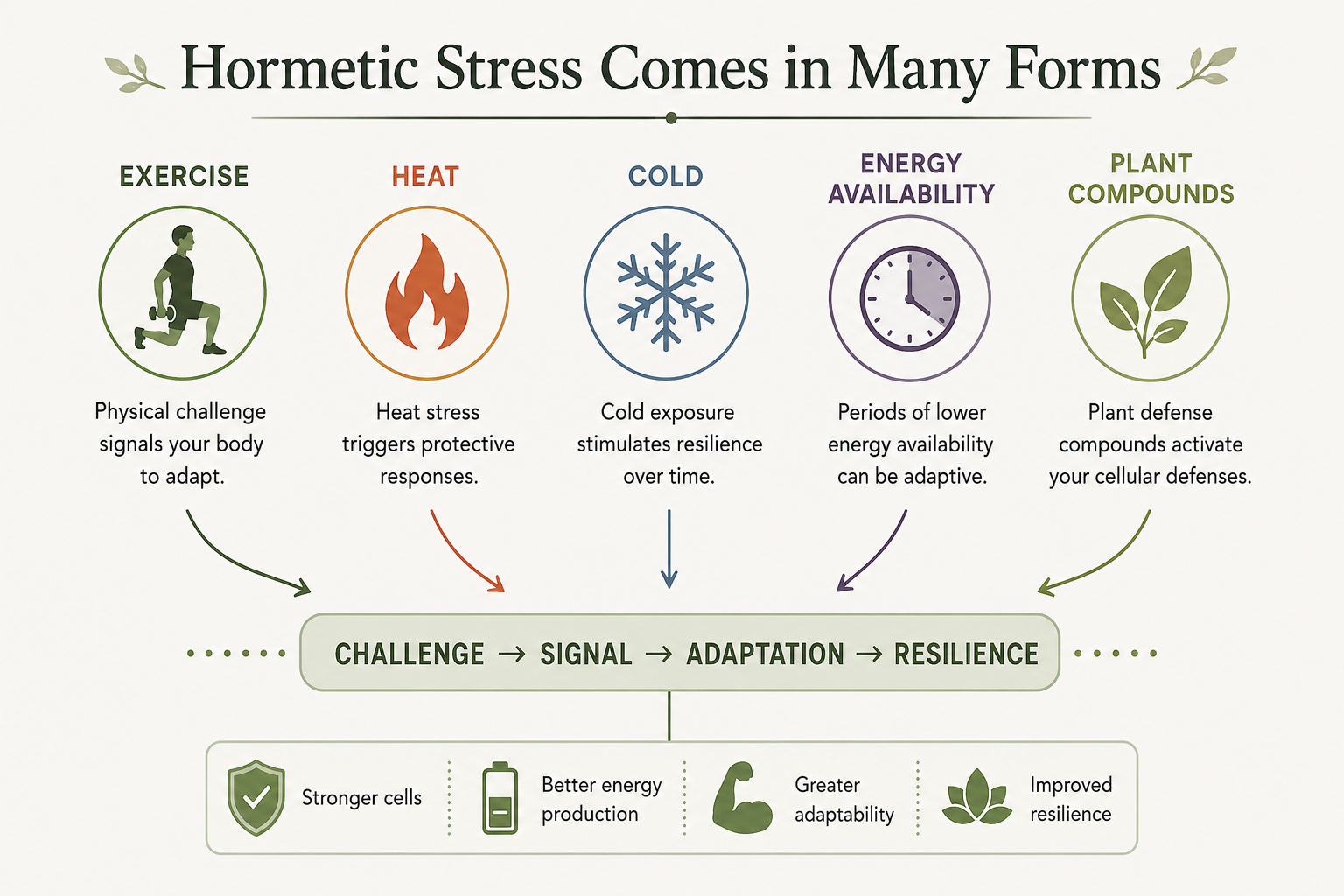
Other Ways We Encounter Hormetic Stress
Exercise isn't the only example.
Heat
Heat exposure creates thermal stress.
One response is increased production of heat shock proteins, which help stabilize, repair and maintain other proteins during cellular stress.
Sauna exposure is one way to create controlled heat stress, although exercise itself also raises body temperature and activates heat-related stress responses.
Cold
Cold presents another environmental challenge.
The body must defend its core temperature through responses involving the sympathetic nervous system, blood vessels, skeletal muscle and metabolically active brown adipose tissue.
Again, the benefit isn't that cold is inherently healthy.
Cold is a stressor.
The biological response to an appropriate cold challenge is what makes the concept interesting.
Periods of Lower Energy Availability
Our cells also respond to changes in energy availability.
When we're constantly eating, cells receive signals indicating that nutrients and energy are readily available.
During periods without food—including the ordinary overnight period between dinner and breakfast—those signals change.
Energy-sensing pathways respond and influence metabolism, cellular maintenance and recycling processes.
This doesn't mean longer fasting is necessarily better.
A 12-hour overnight fast and prolonged food deprivation are not biologically equivalent.
Once again:
Dose matters.
More Hormesis Isn't Better Hormesis
This may be the most important point in the entire discussion.
Once people hear that stress can be beneficial, it's tempting to think:
If a little is good, more must be better.
But that contradicts the entire concept of hormesis.
Exercise can improve health.
Excessive exercise without adequate recovery can contribute to injury and physiological dysfunction.
Heat can trigger adaptive responses.
Enough heat can cause heat stroke.
Cold can produce adaptive responses.
Enough cold causes hypothermia and tissue injury.
Temporary energy restriction produces metabolic signals.
Chronic inadequate energy intake can lead to malnutrition and physiological dysfunction.
And a plant compound that produces beneficial signaling at one exposure isn't necessarily beneficial at every concentration.
The hormetic response exists precisely because the dose determines the response.
Challenge Is Only Half the Equation
There's another piece that tends to get overlooked:
Recovery.
The challenge creates the signal.
Recovery gives the body the opportunity and resources to respond.
Think again about strength training.
You don't become stronger simply because you lifted something heavy.
The exercise creates the stimulus.
Then your body needs adequate protein, micronutrients, energy, sleep and time to repair and adapt.
The same principle applies more broadly to hormesis.
Constantly piling stressors on top of an already overwhelmed system isn't necessarily building resilience.
Sometimes it's simply adding more stress.
The goal isn't to create the most stress possible.
It's to create a manageable challenge that the body has the resources and opportunity to adapt to.
Health Isn't Always the Absence of Stress
This is ultimately why I find hormesis so fascinating.
We're often taught to think about health primarily in terms of removing things:
Reduce oxidative stress.
Reduce inflammation.
Avoid stress.
Avoid toxins.
Take antioxidants.
And certainly there are situations where reducing a harmful exposure is exactly what needs to happen.
But human physiology is built around something more dynamic.
Our cells constantly sense their environment.
They receive signals.
They respond.
They repair.
They adapt.
And sometimes the signal that tells the body to become stronger begins with a challenge.
Challenge → Signal → Adaptation → Greater resilience
Healthy cells aren't necessarily cells that never experience stress.
They're cells that are capable of responding appropriately to it.
And sometimes, a little stress is exactly what gives them the reason to become stronger.